
How to Use This Body Type Calculator
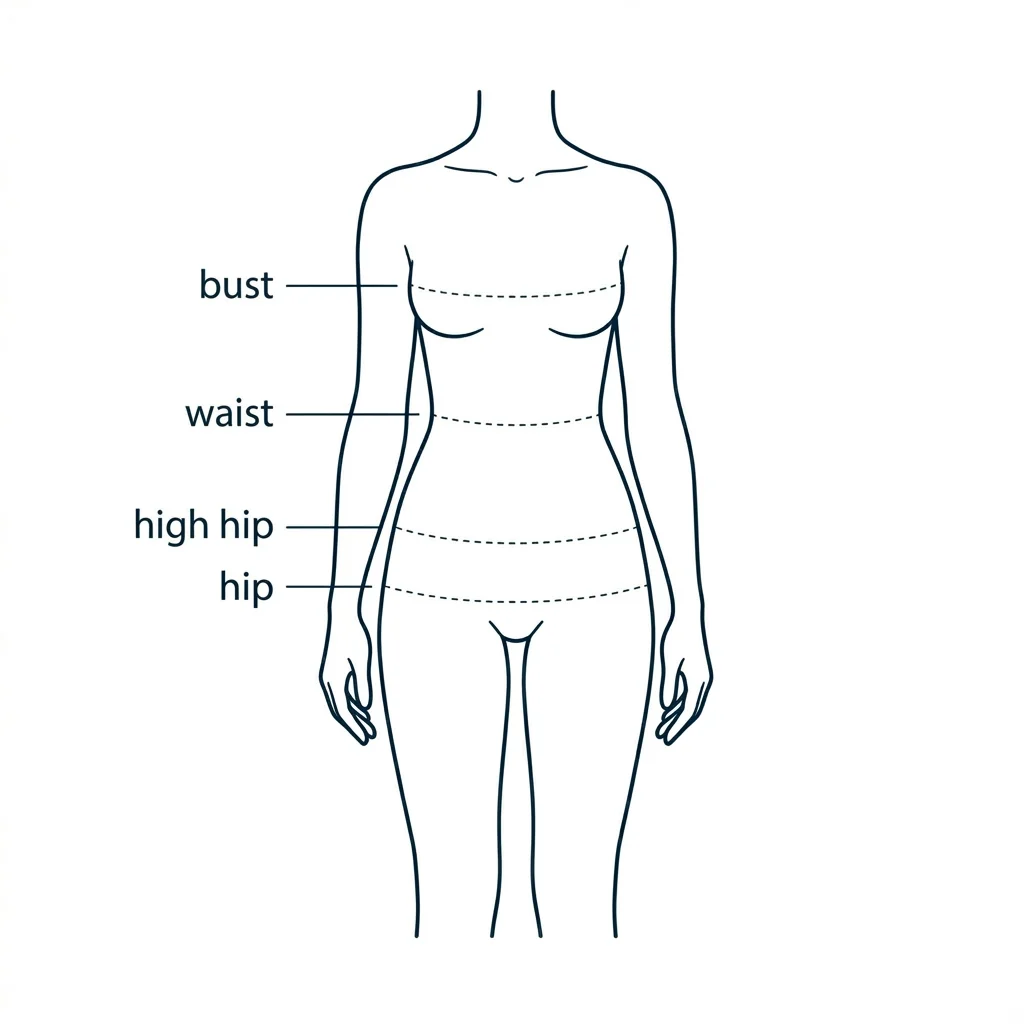
Accurate body shape classification requires four standardized anatomical tape measurements:
- Bust Measurement: Wrap a flexible tailor's tape horizontally across the fullest protrusion of your chest and shoulder blades. Keep the tape parallel to the floor without compressing soft tissue.
- Natural Waist Measurement: Measure around the narrowest circumference of your torso, typically located 1 to 2 inches above your navel. Breathe out naturally; do not suck in your stomach.
- High Hip Measurement: Measure around the upper pelvic ridge (the iliac crest), approximately 3 to 4 inches below your waist. This critical metric separates Spoon from Triangle silhouettes.
- Full Hip Measurement: Measure around the widest anatomical protrusion of your hips and buttocks with feet positioned together.
- Read Your Classification: Review your primary shape profile, mathematical ratio explanations, and your Waist-Hip Ratio (WHR) health risk score.
How It Works: Mathematical Rules for 7 Female Silhouettes
Rather than relying on subjective fashion labels, our calculation engine implements quantitative classification models based on anthropometric sizing methodology (such as research by Lee et al., 2007) and health standards from the World Health Organization (WHO):
1. Hourglass
(Bust - Hips) ≤ 1" AND (Hips - Bust) < 3.6" AND [(Bust - Waist) ≥ 9" OR (Hips - Waist) ≥ 10"]
Balanced bust and hips with an indented, dramatically defined natural waist.
2. Bottom Hourglass
(Hips - Bust) ≥ 3.6" AND < 10" AND (Hips - Waist) ≥ 9" AND (High Hip / Waist) < 1.193
Hips slightly larger than bust with strong waist definition and smooth hip curves.
3. Top Hourglass
(Bust - Hips) > 1" AND < 10" AND (Bust - Waist) ≥ 9"
Bust moderately larger than hips with a sharply tapered natural waistline.
4. Spoon
(Hips - Bust) > 2" AND (Hips - Waist) ≥ 7" AND (High Hip / Waist) ≥ 1.193
Prominent high-hip pelvic shelf combined with distinct waist indentation and wider lower hips.
5. Triangle (Pear)
(Hips - Bust) ≥ 3.6" AND (Hips - Waist) < 9"
Hips substantially wider than shoulders and bust, with straighter transition across the torso.
6. Inverted Triangle
(Bust - Hips) ≥ 3.6" AND (Bust - Waist) < 9"
Broad shoulders and bust with athletic taper into narrower hips.
7. Rectangle
(Hips - Bust) < 3.6" AND (Bust - Hips) < 3.6" AND (Bust - Waist) < 9" AND (Hips - Waist) < 10"
Balanced torso alignment where bust, waist, and hips align in a straight athletic column.
Worked Anthropometric Examples
Every sample calculation below has been verified in our test suite:
Example 1: Classic Hourglass (Balanced Curves)
Measurements: Bust 36", Waist 24", High Hip 32", Hips 36"
- Bust - Hips: 36 - 36 = 0" (satisfies ≤ 1")
- Bust - Waist: 36 - 24 = 12" (satisfies ≥ 9")
- Hips - Waist: 36 - 24 = 12" (satisfies ≥ 10")
- Shape Classification: Hourglass
- WHR: 24 / 36 = 0.67 (Low Risk / Optimal)
Example 2: Spoon Shape (High-Hip Shelf Definition)
Measurements: Bust 34", Waist 27", High Hip 33", Hips 36.5"
- Hips - Bust: 36.5 - 34 = 2.5" (satisfies > 2")
- Hips - Waist: 36.5 - 27 = 9.5" (satisfies ≥ 7")
- High Hip / Waist Ratio: 33 / 27 = 1.2222 (satisfies ≥ 1.193 shelf threshold)
- Shape Classification: Spoon
- WHR: 27 / 36.5 = 0.74 (Low Risk / Optimal)
Example 3: Triangle (Pear) Silhouette
Measurements: Bust 34", Waist 30", High Hip 32", Hips 38"
- Hips - Bust: 38 - 34 = 4.0" (satisfies ≥ 3.6")
- Hips - Waist: 38 - 30 = 8.0" (satisfies < 9")
- Shape Classification: Triangle
- WHR: 30 / 38 = 0.79 (Low Risk / Optimal)
Waist-to-Hip Ratio (WHR) Health Risk Standards
According to the World Health Organization 2008 Expert Consultation, abdominal visceral adiposity represents a primary risk factor for type 2 diabetes and cardiovascular disease:
| WHR Range (Females) | Health Risk Classification | Standard Authority | Fat Distribution Pattern |
|---|---|---|---|
| ≤ 0.80 | Low Risk (Optimal) | WHO / NIDDK | Gynoid (peripheral lower-body fat storage) |
| 0.81 to 0.85 | Moderate Risk | NIDDK Threshold | Intermediate adipose distribution |
| > 0.85 | High Risk (Elevated) | WHO Cutoff Point | Android (central visceral abdominal adiposity) |
Common Measuring Pitfalls to Avoid
1. Sucking in the Stomach
Holding your breath artificially contracts abdominal muscles, underestimating your waist circumference by 2 to 4 inches and distorting your WHR screening score. Relax and exhale naturally before reading the tape.
2. Misplacing the High Hip
The high hip is not the widest part of your hips. It sits on top of your pelvic crest (3 to 4 inches below the waist). Measuring too low turns a Spoon into a Rectangle.
3. Slanted Tape Lines
If the tape drops at the back across your shoulder blades or hips, the circumference reading will be artificially inflated. Always stand before a mirror to ensure the tape remains strictly horizontal.
When to Use This Tool vs. Related Solvers
- Analyzing health body composition? Combine WHR with Body Mass Index (BMI) and physical fitness assessments for a holistic view.
- Calculating descriptive central tendency metrics or grading datasets? Use our One Calculator Average Solver.
- Estimating materials for home improvement or landscaping? Use our Gravel Estimator.
Health Screening Disclaimer
This calculator provides educational anthropometric classification and epidemiological screening metrics based on population statistics. It does not provide medical diagnosis, clinical prognosis, or personalized nutritional therapy. Consult a certified medical practitioner or registered dietitian for clinical health assessments. Read our full medical and health disclaimer.
Frequently Asked Questions
How does the calculator determine my body shape? ↓
The calculator evaluates mathematical differences between bust, waist, high hip, and full hip circumferences using classification models based on anthropometric sizing research. It categorizes silhouettes into seven standard anthropometric shapes based on apparel sizing research (ISO 8559-1): Hourglass, Bottom Hourglass, Top Hourglass, Spoon, Triangle (Pear), Inverted Triangle, and Rectangle.
Where exactly is the high hip measured compared to the full hip? ↓
The high hip is measured across the top of your pelvic hip bones (the iliac crest), approximately 3 to 4 inches below your natural waistline. The full hip is measured around the widest anatomical protrusion of your buttocks, typically 7 to 9 inches below your natural waist.
What is the Waist-to-Hip Ratio (WHR) and what does it indicate? ↓
Waist-to-Hip Ratio (WHR) divides waist circumference by full hip circumference. According to World Health Organization (WHO) expert consultation benchmarks, a female WHR of 0.85 or higher denotes substantially elevated metabolic and cardiovascular risk associated with abdominal visceral fat, while a ratio of 0.80 or below serves as a standard low-risk clinical baseline.
What is the difference between a Spoon and a Triangle (Pear) shape? ↓
Both shapes feature hips substantially larger than the bust. However, a Spoon body type possesses a prominent upper hip shelf where the high hip to waist ratio is 1.193 or greater, paired with distinct waist indentation. A Triangle or Pear shape widens more gradually through the lower hips and thighs without the pronounced high-hip ledge.
Does weight loss or muscle gain change my body type? ↓
Yes. While underlying skeletal architecture (pelvic width, ribcage breadth, and clavicle span) remains genetically fixed, shifts in adipose tissue distribution and muscle hypertrophy can modify circumference ratios, potentially shifting a profile between Rectangle, Hourglass, or Spoon.
Can I input measurements in centimeters rather than inches? ↓
Yes. Each input field features an independent unit toggle allowing you to enter measurements in inches or centimeters. The algorithm automatically standardizes metric values before evaluating mathematical thresholds.
Explore Body Shape & Health Guides
Sources & References
- World Health Organization (WHO) — Waist Circumference and Waist-Hip Ratio: Report of a WHO Expert Consultation. Geneva, 8-11 December 2008.
- International Organization for Standardization — ISO 8559-1: Size designation of clothes — Part 1: Anthropometric definitions for body measurement.
- National Institute of Diabetes and Digestive and Kidney Diseases (NIH / NIDDK) — Health Risks of Overweight & Obesity: Abdominal Fat Distribution Guidelines.